
The complete guide
H3 Halogen Headlight Bulbs - A Practical Buyer's Guide
The problem nobody notices until it is dark
Headlight bulbs do not usually fail on a bright afternoon. They go on a wet night, on an unlit road, at the exact moment you want to see further than you can. And they rarely fail politely. One side drops out, the car suddenly throws light at a strange angle, and you spend the rest of the drive leaning forward over the wheel.
The other version of this problem is slower and sneakier. Halogen bulbs dim as they age. The filament thins, the glass picks up a faint haze, and the light gets a little weaker every month. Because it happens gradually, most drivers never notice until they fit a fresh bulb and think, oh, that is what it is meant to look like.
A pair of H3 halogen headlight bulbs solves both versions of the problem. You replace the one that failed and the one that is quietly on its way out, and the two sides go back to matching.
What an H3 bulb actually is
It describes the shape of the bulb so that any H3 will physically drop into any H3 socket.
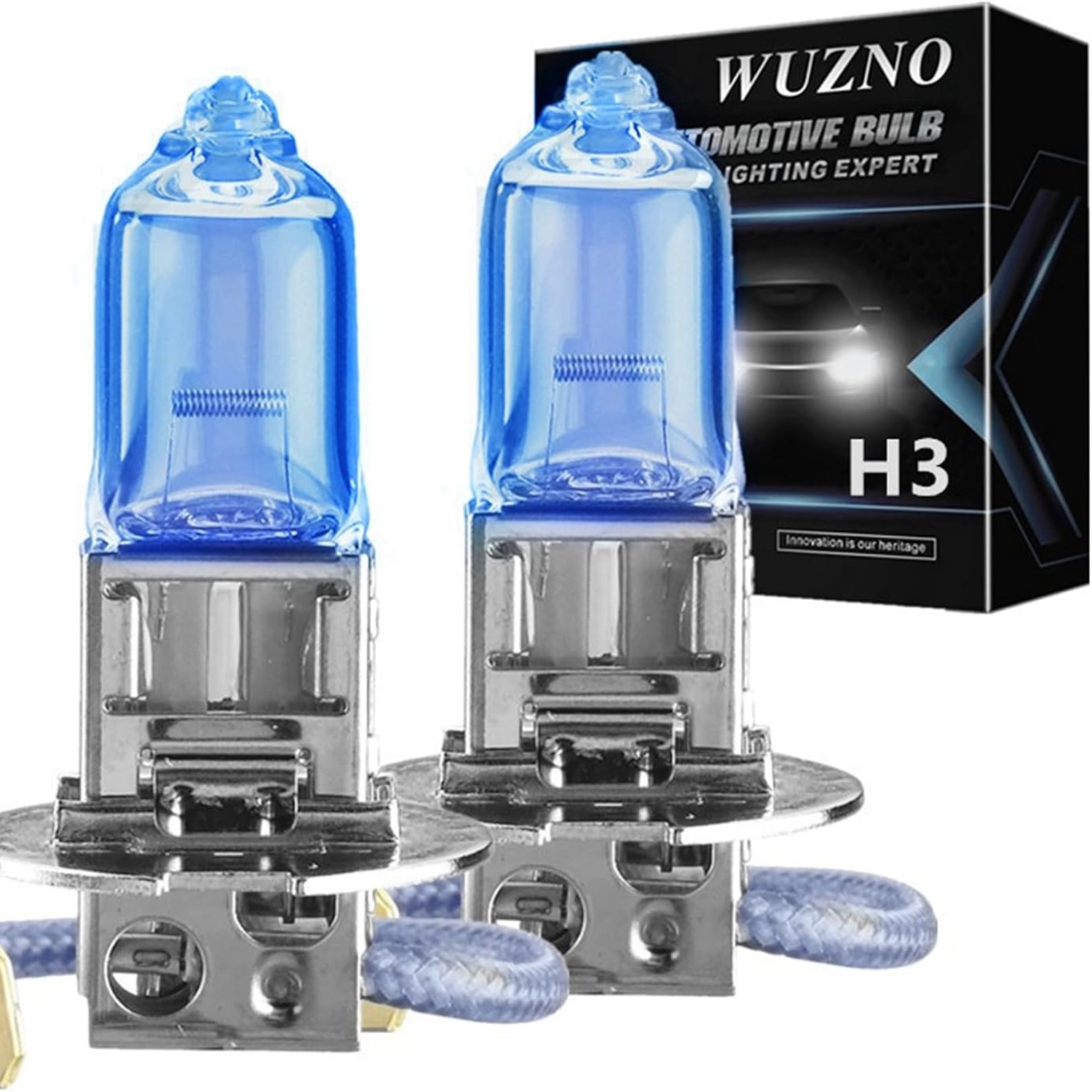
The shape is simple. There is a small quartz glass capsule holding a single filament, a flat metal flange that seats the bulb in the housing at the right depth and angle, and a short wire tail with a spade terminal on the end. That is it. No multi-pin base, no plastic keyway with three different tabs to line up.
The simplicity matters when you are kneeling on wet tarmac with a torch in your teeth. There is not much to get wrong.
These particular bulbs run at 12 volts and 55 watts, which is the normal rating for an H3. The quoted colour temperature is 5000 Kelvin, a cool white tint rather than the warmer yellow look of some older bulbs.
Colour temperature, in plain words
Kelvin numbers confuse a lot of people, so here is the short explanation. Kelvin tells you the colour of the light, not the amount of it.
Low numbers look warm and yellow, like an old filament lamp. High numbers look cool and white, and very high numbers start drifting toward blue. At 5000K you get a clean white that most people describe as closer to daylight.
This is a preference, not a performance figure. A whiter bulb does not automatically throw light further than a warmer one. If you like the look of a crisp white beam, 5000K gives you that. If you drive in heavy fog a lot, some people prefer a warmer tint, which is a reasonable personal choice rather than a rule.
Checking the fitting before you order
This is the one step worth slowing down for, because getting it right takes two minutes and getting it wrong wastes a week.
There are two ways to check. The second, and the more reliable of the two, is the old bulb itself. Pull it out and read the base. The fitting type is almost always stamped or printed on the metal flange or the plastic collar, along with the voltage and wattage.
We do not publish vehicle fitment lists for bulbs. That is deliberate. The same car model can leave the factory with different lighting packages depending on trim level, market and production year, so a model-based list gives false confidence. Fitting type is the fact that actually decides whether the bulb goes in.
If the marking on your old bulb has worn away, send us a clear photo and we will tell you what we can see.
Fitting them without drama
Work with the engine off, the lights off, and the bulbs cool. Halogen bulbs get very hot, and the housing holds that heat for a while after you switch off. There is no prize for being quick about it.
Access is usually the hardest part. Depending on the car you might reach the lamp from behind in the engine bay, or you might need to turn the wheel and move a section of the arch liner. Have a look before you buy anything else, because sometimes the job is five minutes and sometimes it is thirty.
Once you are at the bulb, unplug the wire tail, release the clip or retaining ring, and lift the old bulb out. The new one goes in the same way, seated flat against the flange so it sits at the right depth.
Here is the rule people forget. Do not touch the glass with bare fingers. The oil from your skin leaves a film, that film creates a hot spot when the bulb heats up, and the bulb can fail early as a result. Hold the metal base or the plastic collar, or wear a clean glove. If you slip and touch the glass, wipe it with a lint-free cloth and a little methylated spirit, then let it dry before fitting.
Check the beam before you pack up. Switch the lights on, look at the pattern against a wall or a garage door, and make sure both sides are lit and sitting at a similar height.
Who this pair suits
Anyone replacing a failed H3 bulb, obviously. But a few other people get good value from a pair as well.
Drivers who want both sides to match are the main group. If only one bulb has gone and you replace just that one, the new bulb often looks noticeably whiter than the aged one beside it, which looks odd and can be distracting at night.
Then there are the people who keep a spare in the boot. If you drive long distances, or anywhere remote, a spare bulb takes up almost no room and saves a bad evening. Buying a pair and fitting one gives you a matched spare ready to go.
Home mechanics on a routine service also tend to buy in pairs. If the car is already up on stands and the arch liner is off, swapping both bulbs while you are in there is sensible.
What we are not claiming
Worth being direct about this.
We also do not claim any approval marking for this bulb. If your use requires a bulb with a particular marking, check what is printed on your old bulb and ask us before ordering rather than assuming.
The facts we can stand behind are the ones in the spec table. H3 fitting, halogen, two bulbs per pack, 12 volts, 55 watts, 5000K colour temperature. Everything else is for you to verify against your own vehicle.
Looking after them
There is not much maintenance to a bulb, but a couple of habits help.
Keep the spare in its packaging until you need it, somewhere dry and away from loose tools. Glass and a toolbox do not mix well. Clean contacts matter too, so if the connector in your car looks corroded, a light clean before fitting is worth the effort.
When the time comes to change them again, handle them by the base, let them cool first, and dispose of the old ones sensibly rather than dropping them loose in a bin where someone could cut themselves on broken glass.
The short version
An H3 bulb is a simple, single-filament halogen bulb with a flat flange and one wire tail.
Check the fitting on your old bulb or in the manual before you order. Fit both sides so they match. Do not touch the glass, and let everything cool before you start.
Do that and the job takes less time than reading this guide.